
Projects Myend
End-of-life planning, made simple
Myend is where a person puts their own affairs in order, years before anyone needs them: the will, the medical directives, the funeral, the accounts and passwords, the things they want said. Gallatin River built three parts. The app people use, the website they arrive from, and the agent office that runs the company behind both.
The conversation
Justine asks one question at a time, and drafts the document while you answer.
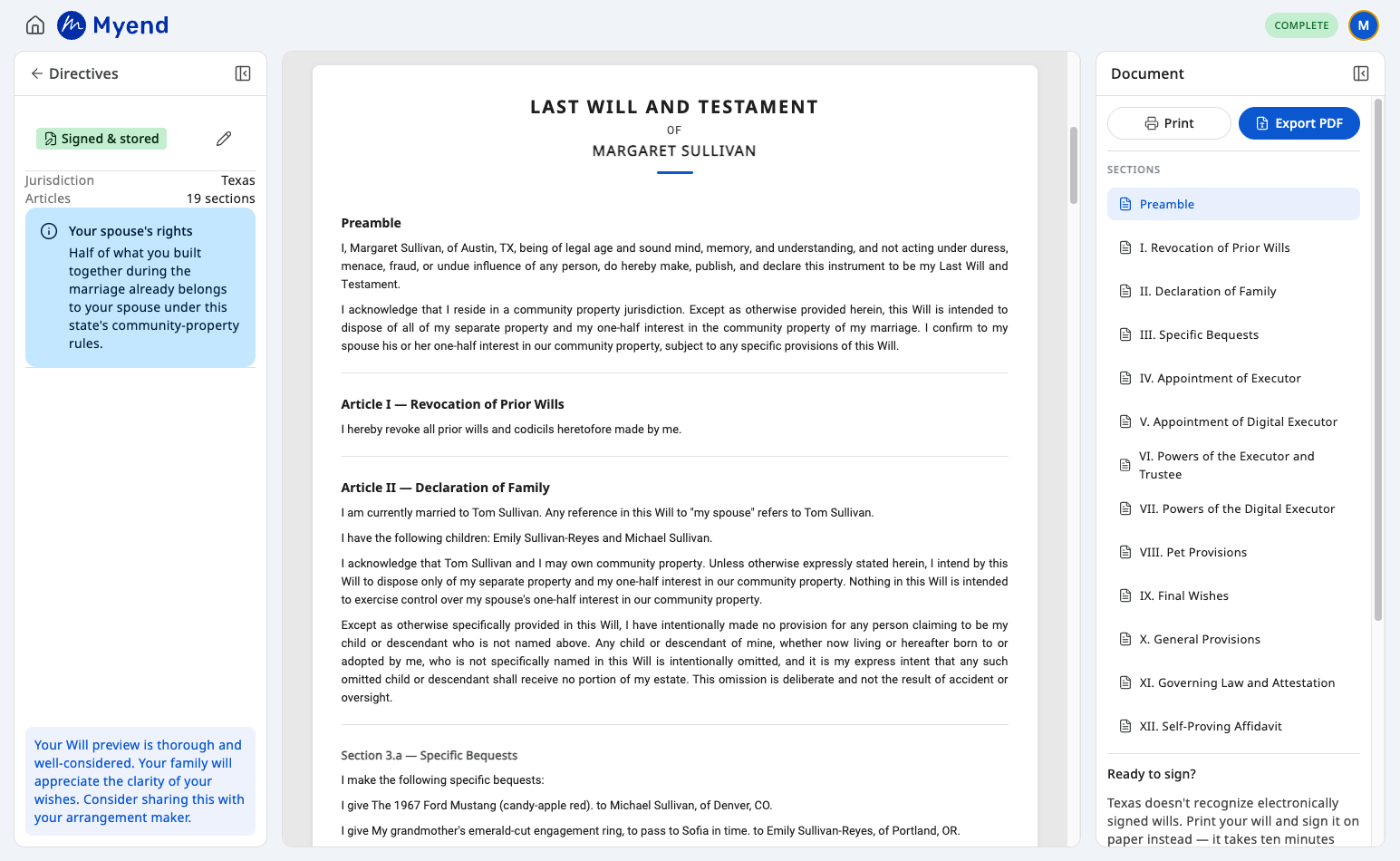
Myend opens with a conversation instead of a form. Justine, the AI guide, asks about medical care, the funeral, the will, who gets what, one question at a time, in the words a person would actually use. The answers become the document as you go. You can answer three questions on a Tuesday evening and stop.
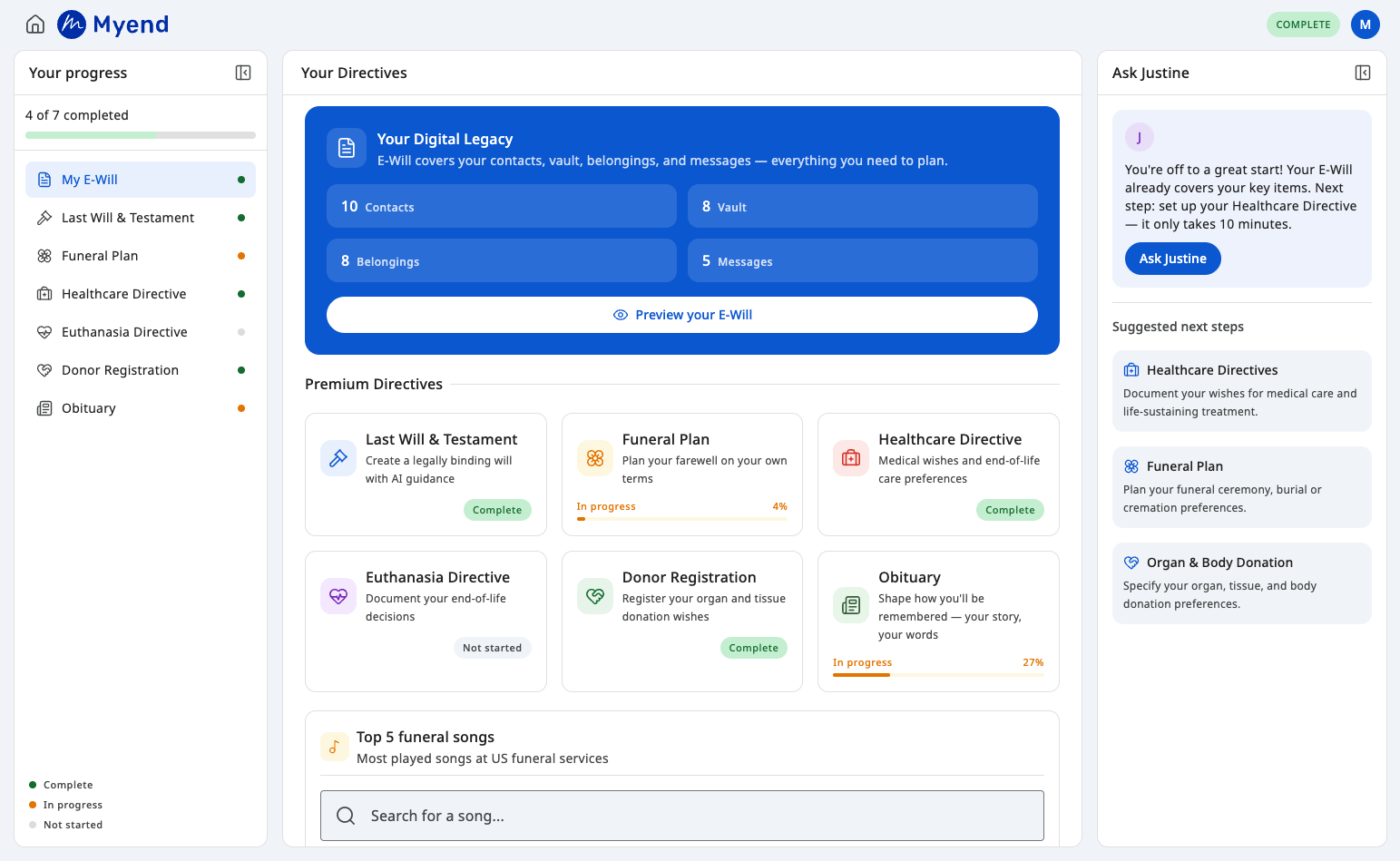
What comes out is a set of finished things: a healthcare directive, a funeral plan, a donor directive and a last will and testament. Beside them sits the e-will, which covers the part a legal will cannot reach: the accounts, the passwords, the online life, and who should get which. Then the vault for bank details and documents, belongings photographed and assigned, messages and goodbyes addressed to named people, and Memory Lane for the stories and the playlists.
The will is written to the rules of the state the person lives in. Every US state plus Washington DC sets its own requirements for witnesses and notarisation, 51 sets in total, and Myend applies the right one and says plainly what that state needs. It produces a print-ready PDF and will not sign it electronically, because an electronic signature does not make a will valid.
860 legal assertions sit under automated test, so a state changing its rules surfaces as a failing test rather than as somebody’s problem years later. Justine drafts. She is not a lawyer, and the product says so.
The handover
Legacy Contacts accept the job long before there is anything to do.
You name two or three people you trust. Each one gets an email explaining the role, accepts or declines it, and sets up a free account where they can see exactly what will be asked of them and exactly what they will and will not be able to open. Then nothing happens, possibly for decades.
Proof of Life decides when that changes. Myend checks in from time to time. Answer, and nothing moves. Stop answering across several rounds and the contacts are notified and given the access that was set for them. The timing is not a contact’s judgement call and not a document somebody uploads. The check-in is what decides.
Access is partitioned rather than handed over whole. A contact sees the messages addressed to them, the list of belongings and who they go to, an overview of the vault with only the codes meant for them, and the contact list for the will. The partition is set while the person is alive, and the roles can be changed at any point.
| Before | After | |
|---|---|---|
| Messages addressed to them | nothing | shown |
| Belongings, and who gets them | nothing | shown |
| The vault | nothing | their codes only |
| Contacts for the will | nothing | shown |
Proof of Life is what moves a column.
What changes
Nobody has to guess later.
Almost everything in a plan is something one person knows and nobody else does. Which bank. Which policy. Burial or cremation. Whether the ring goes to the daughter or the niece. Gathered afterwards, those become guesses dressed as decisions. Myend gathers them first.
It is built to be done in pieces. There is no appointment and no minimum session. The plan stays editable for as long as there is someone editing it, and every document exports as a PDF at any point. There is no subscription on the plan, which matters for a product that has to still be there in thirty years.
And the people who will need it have already been told. They accepted the role, they have read what it involves, and they will be notified when it starts. Nobody has to search a drawer for a password.
  you answer the questions
  ████

  check-ins answered, nothing moves
  ·······································

  check-ins stop
                                         ▌
  the plan opens
                                         ████

The long quiet middle is the product working.
The app
We cannot open your vault. Nobody at Myend can.
The vault is encrypted end to end, so the server holds it without being able to read it. That is a constraint on the company rather than a feature of it. There is no support path that ends with someone here opening a customer’s vault, because there is no way to build one.
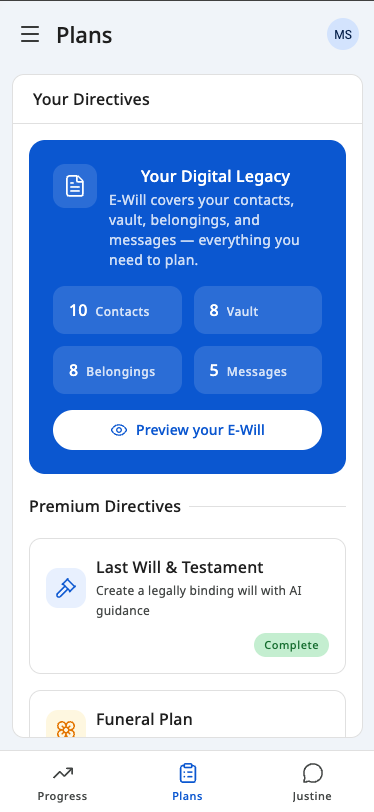
One build serves iOS, Android and the web, so a plan started on a laptop is already on the phone, behaving the same way on both. It keeps working with no connection and reconciles when one returns.
The app was moved onto new foundations without asking a single person to reset a password they had not chosen to reset. The measure of that work was that nobody noticed it happen.
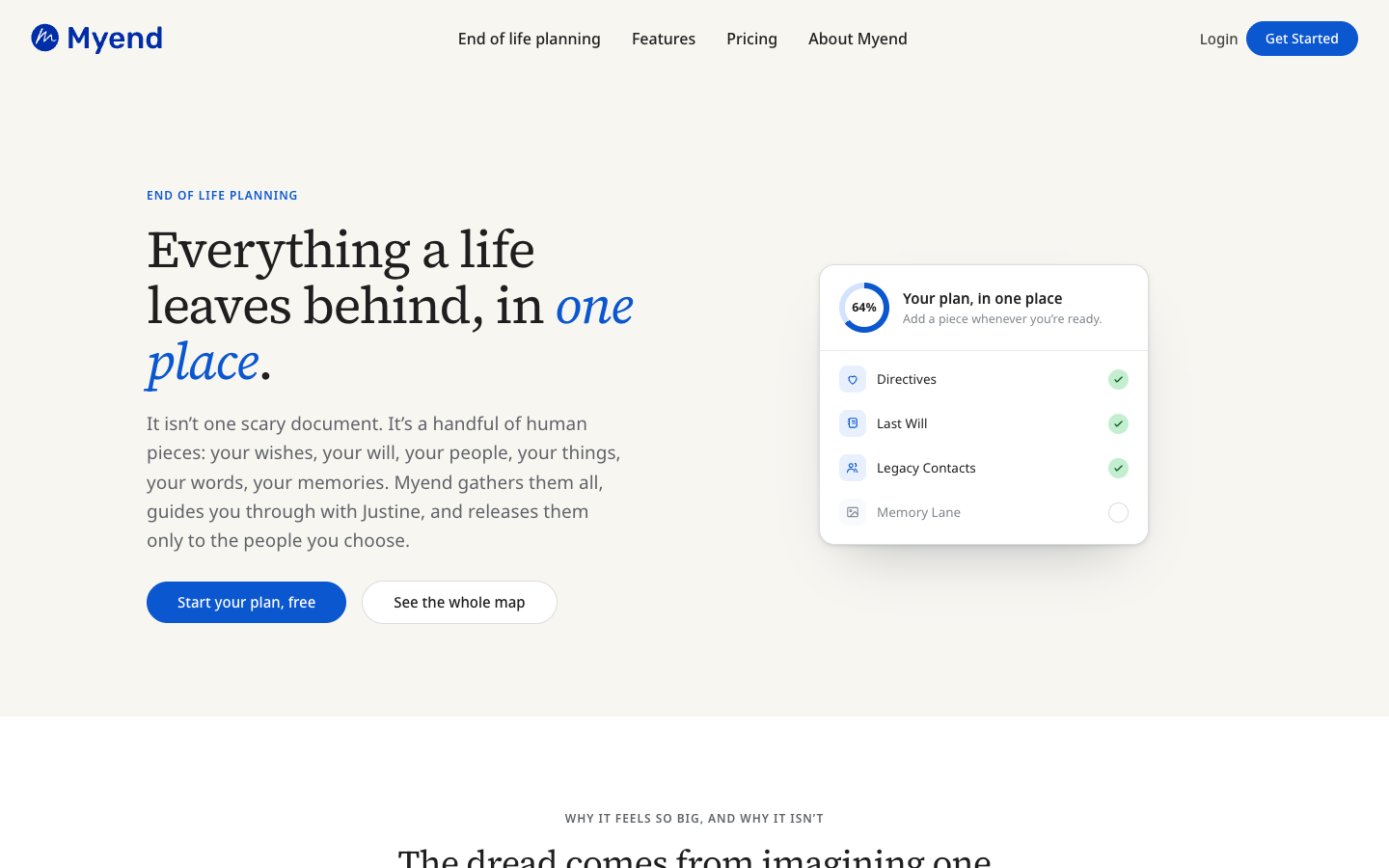
myend.com
The rebuild had to be invisible, because the search results are the front door.
People reach Myend by typing a question, usually a specific one. What two witnesses actually means in Ohio. What an executor is responsible for. What happens to a bank account when the holder dies. More than four hundred pages answer questions like those, and that library is how the product gets found.
Rebuilding it meant moving every one of those pages without losing the positions they had earned. Titles and descriptions on ranking URLs were locked before anything moved, the new pages were checked against the old byte for byte, and the redirect map was generated rather than typed by hand. Hosting moved in the same window, with a DNS flip kept ready as the rollback.
The pages are written under a pipeline, not by a model handed a topic. Research agents produce a fact sheet, the writer is held to it, and anything touching grief goes through an adversarial review before it publishes. The chat widget runs a crisis check ahead of every other check it makes.
The office
Six agents run the back office, and one of them exists to disbelieve the others.
Myend has an office, and almost nobody works in it. Six departments are held by agents: product, legal, marketing, users, operations and content. Each has its own standard operating procedures and a department handbook, written the way you would write them for a new hire. Between them they watch three codebases, keep the automations running, triage the support mail, and check every few minutes that the product is actually up.
Work arrives as orders rather than as chat. An order names a repository, a department and a job. One waiting this morning reads: five US jurisdictions carrying wrong citations, a wrong no-contest standard and a wrong executor rule. That is the office finding a defect in the legal engine described further up this page, writing it up, and putting it in the queue.
The centre of it is the work-order bridge. An executor agent takes the order, does the job, and reports what it did. A critic agent then picks up the same order with no shared context and treats that report as unverified: it re-runs the tests itself, diffs the change against what was actually asked for, and checks anything claimed but not shown. A resolver decides what ships. The critic reads the work, never the summary.
The office writes in sentences. It says nobody is waiting for a reply, rather than showing a zero. When its own health check stopped answering this morning, the first thing on the screen was that it could not tell whether anything was broken, and that nothing below was verified. A status board that reports green when it cannot see is worse than no status board, so this one says what it does not know.
Those handoffs are structural. The approval gates sit in the architecture, not in a prompt, because a prompt can be argued out of a rule and a code path cannot. Anything touching grief or a legal claim goes to a person, and always will.
Order     five jurisdictions, wrong citations
Executor  did the job, reports it done

Critic    picks it up with no shared context
          re-ran the suite           green
          diffed against the order   1 out of scope
          checked what was claimed   unverified

Resolver  1 blocked, 1 returned

The critic reads the work, never the summary.
We build the product, then we build the office that runs it.
The work worth handing over is long, repetitive, badly timed, and currently held together by one person and a spreadsheet. If something in your business has that shape, we should talk.